
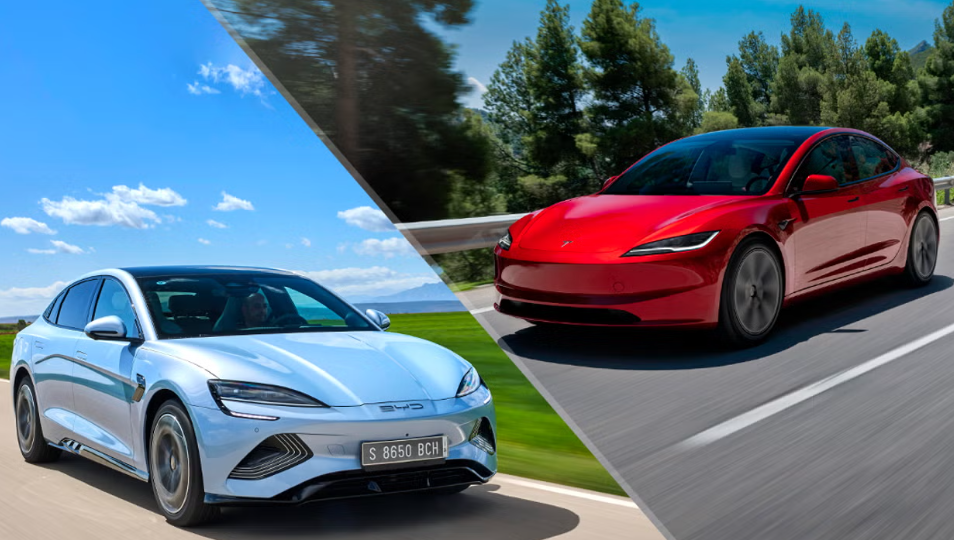
The electric vehicle industry has witnessed one of the most dramatic competitive shifts in automotive history. BYD, a Chinese battery and car manufacturer once dismissed by Tesla CEO Elon Musk, has risen to challenge and even surpass Tesla as the world’s largest electric vehicle producer. This transformation tells a compelling story about innovation, market strategy, and the rapid evolution of China’s automotive industry.
The Dismissal That Aged Poorly
In 2011, Tesla CEO Elon Musk dismissed BYD during a Bloomberg interview, asking “Have you seen their car?” and stating “I don’t think it’s particularly attractive, the technology is not very strong”. Musk went further, predicting BYD’s focus should be on avoiding collapse in their home market.
Fast forward to 2024, and the narrative has completely reversed. BYD Auto leads China’s EV market with 34.1% market share, delivering 4.27 million vehicles in 2024. BYD has not only survived—it has thrived, becoming a formidable global competitor that Tesla can no longer ignore.
The Numbers Tell the Story
The competition between these two giants reveals striking contrasts:
Market Performance:
- BYD delivered 4.27 million vehicles in 2024, capturing 34.1% of China’s massive EV market
- BYD sold 373,626 new energy vehicles in a single month (August 2025), though experiencing atypical stagnation with only 0.15% year-over-year growth
- Tesla China sold 83,192 electric cars built in Shanghai in August 2025, 4% less than a year ago
Recent Challenges: Tesla’s sales in China dropped by 7.4% year-over-year from January through November 2025, while market leader BYD reported a 5.1% decline during the same period. Both companies face intensifying competition from newer entrants and the effects of a brutal price war.
What Makes BYD Different?
Vertical Integration: BYD’s greatest advantage lies in its comprehensive control over the supply chain. Unlike Tesla, which relies on external suppliers for critical components, BYD manufactures its own batteries, semiconductors, and many other key parts. This vertical integration strategy provides:
- Cost control advantages in a price-sensitive market
- Faster response to component shortages
- Greater flexibility in design and manufacturing
- Protection from supply chain disruptions
Battery Innovation: BYD’s Blade Battery technology has become a key differentiator, offering improved safety, longevity, and cost-effectiveness. The Blade Battery uses lithium iron phosphate (LFP) chemistry, which is cheaper and safer than the nickel-based batteries commonly used by Tesla in many markets.
Product Range: While Tesla focuses primarily on premium segments with limited model variety, BYD offers an extensive portfolio spanning budget-friendly compacts to luxury sedans and SUVs. This diversification allows BYD to capture multiple market segments simultaneously.
The Chinese Market Advantage
Home Court Dominance: China’s EV market penetration reached approximately 48% of total car sales in 2024, jumping from just 6.3% in 2020. This massive domestic market provides BYD with economies of scale that few competitors can match.
The Chinese electric vehicle market accounts for over 70% of global EV production, with domestic sales exceeding 11 million vehicles in 2024. Operating in this environment gives BYD unparalleled testing grounds and rapid feedback loops for product development.
Government Support: Chinese manufacturers benefit from substantial policy support, including purchase subsidies, infrastructure investment, and favorable regulations. While these advantages are being gradually phased out, they provided crucial momentum during BYD’s growth phase.
Tesla’s Strengths and Challenges
Brand Prestige: Tesla maintains significant advantages in brand perception, particularly in Western markets and among affluent Chinese consumers who view it as a premium, aspirational brand. The Model 3 and Model Y remain popular despite increasing competition.
Technology Leadership: Tesla’s Autopilot and Full Self-Driving capabilities, Supercharger network, and over-the-air software updates continue to set industry benchmarks. The company’s focus on software-defined vehicles positions it well for future autonomous driving developments.
Global Manufacturing: Tesla’s Gigafactories in multiple countries provide geopolitical diversification that BYD is only beginning to replicate. However, this advantage is narrowing as BYD expands internationally.
Challenges in China: Tesla saw sales drop by 7.4% year-over-year in China from January through November 2025, reflecting intensifying local competition and price pressure. Chinese consumers increasingly view domestic brands as offering equal or superior value.
The Fierce Price War
Both companies face unprecedented pricing pressure in China’s crowded EV market.
China’s electric car market ended 2025 on a soft note, with analysts warning that a fierce price war is likely to persist, with discounts reaching 432,000 yuan ($61,660) for premium models like the Mercedes-Benz EQS EV.
Industry experts noted that BYD’s aggressive discounting policy was intended to clear dealer inventory amid slower sales, but it backfired by eroding dealer profits and disrupting market pricing, triggering consumer dissatisfaction.
This price competition benefits consumers but squeezes margins for all manufacturers, forcing consolidation and potentially eliminating weaker players.
Global Expansion Strategies
BYD’s International Push: BYD recorded 80,813 NEV exports for foreign markets in August 2025, up 157% year-over-year. The company is establishing manufacturing facilities in Brazil, Thailand, Hungary, and other strategic markets to circumvent trade barriers and reduce shipping costs.
China’s EV industry spent more on factories abroad than at home for the first time on record during 2024, signaling a major strategic shift toward global production.
Market Reception: Chinese EV brands have rapidly made inroads in EV-friendly Norway, capturing a combined market share of roughly 10% since the first delivery of an MG car in January 2020. However, Western markets remain challenging due to tariffs, regulatory hurdles, and brand perception issues.
Tesla’s Established Presence: Tesla maintains first-mover advantages in established markets with existing Supercharger networks, service infrastructure, and brand recognition. The company’s early international expansion provides a cushion against Chinese competition in many regions.
Trade Barriers and Geopolitics
The competition extends beyond product quality and pricing into the realm of international trade policy.
Both the U.S. and European Union have imposed duties on Chinese-made EVs to protect traditionally dominant American and European brands. These tariffs significantly impact BYD’s pricing competitiveness in crucial Western markets.
However, BYD’s response—establishing local manufacturing—may ultimately strengthen its position by creating jobs and political goodwill in target markets.
The Road Ahead
Market Maturation: China’s electric car market is already saturated, with new energy vehicles accounting for 59.4% of new passenger cars sold in November 2025. This saturation is pushing both BYD and Tesla to prioritize international expansion and higher-margin products.
UBS predicts the growth rate of China’s electric car sales will roughly halve from around 20% in 2025, forcing manufacturers to compete more fiercely for market share rather than riding overall market growth.
Technology Race: The next battleground will be autonomous driving, battery efficiency, and software capabilities. Both companies are investing heavily in these areas, with success determining future market leadership.
Consolidation Ahead: Analysts expect an industry shake-out in China’s domestic market before too long, with many startups struggling to turn a profit in an increasingly crowded field. Survivors will emerge stronger, potentially including joint ventures between Chinese and Western manufacturers.
What This Means for Consumers Globally
The BYD-Tesla rivalry benefits consumers worldwide through:
- Accelerated Innovation: Competition drives rapid technological advancement in battery technology, charging speeds, and vehicle intelligence
- Price Pressure: Intense competition keeps prices competitive across all market segments
- Greater Choice: Consumers can choose from an expanding array of electric vehicles at multiple price points
- Global Standards: Competition pushes manufacturers to meet increasingly stringent quality and safety standards
Conclusion
The transformation of BYD from a dismissed competitor to Tesla’s primary rival represents more than a corporate success story—it signals a fundamental shift in the global automotive industry’s center of gravity. While Tesla pioneered the modern electric vehicle and remains a formidable innovator, BYD’s manufacturing scale, vertical integration, and home market advantages have created a genuine competitive threat.
Neither company faces an easy path forward. Both must navigate slowing Chinese market growth, international trade barriers, intensifying competition from traditional automakers, and the technical challenges of autonomous driving. However, their rivalry drives the entire industry forward, accelerating the global transition to electric mobility.
By 2030, China is expected to manufacture 36 million vehicles per year, or four out of every 10 cars built globally, cementing its position as the world’s automotive manufacturing hub. In this landscape, both BYD and Tesla will play crucial roles, though likely with different strengths and market positions than today.
For consumers, dealers, and industry observers, the BYD vs. Tesla competition offers a front-row seat to the most significant automotive transformation in over a century. The winner? Ultimately, it may be the global adoption of electric vehicles itself.