
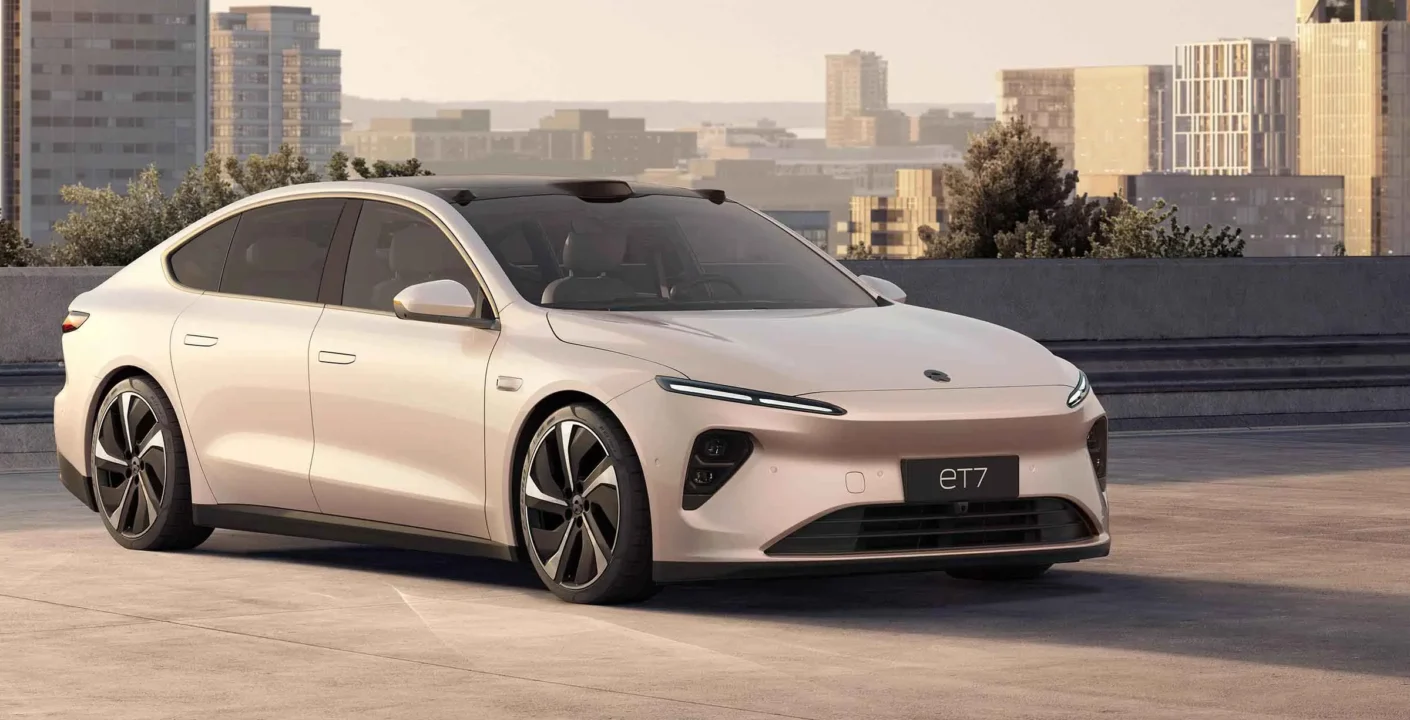
Here’s the corrected version:
From AI-powered autonomous driving to solid-state batteries and gigacasting, Chinese automakers aren’t just competing — they’re rewriting the rules of the global car industry.
The global automotive landscape is shifting fast. China is firmly in the driver’s seat. In 2025, China’s auto market hit a record 34.5 million vehicle sales. Moreover, new energy vehicles (NEVs) accounted for over 50% of the total — a milestone no other country has reached. Now, as 2026 unfolds, the technology gap between Chinese automakers and Western rivals is widening even further.
This isn’t just about cheaper electric cars anymore. In fact, Chinese companies are leading in autonomous driving, AI-integrated cockpits, next-generation batteries, and advanced manufacturing.
Level 3 Autonomous Driving Goes Mainstream
2026 is the year self-driving goes from prototype to production in China. The Ministry of Industry and Information Technology (MIIT) has granted market access for the first batch of Level 3 autonomous vehicles. As a result, China is one of the first major markets to see widespread L3 commercialization.
Companies like BYD, XPeng, Li Auto, Changan Deepal, Arcfox, GAC, and Huawei are already running pilot operations. Investment bank Daiwa estimates up to 1 million L3-capable vehicles could be built this year. Furthermore, XPeng is pushing toward Level 4 — including fully driverless parking — by end of 2026.
Tesla recently opened a China-based AI training hub. The goal is to advance its Full Self-Driving software. Chinese road conditions generate data impossible to replicate elsewhere. However, local rivals like Huawei and XPeng have trained on Chinese driving data for years. This gives them a significant head start.
AI-Powered Vehicles: From Cockpits to Chassis
Artificial intelligence is no longer just a feature. Instead, it’s becoming the foundation of the entire vehicle architecture. At CES 2026, Chinese automakers dominated the AI automotive space.
Geely unveiled its G-ASD system, featured across 16 models under Zeekr and Lynk & Co. The system handles underground parking, highway driving, and complex urban scenarios. In addition, Geely plans to launch commercial robotaxi operations in 2026. By 2030, the company predicts cars will have emotional awareness and proactive service.
Great Wall Motor showcased its ASL 2.0 Smart Agent. This system expands autonomous capabilities to urban commuting and long-distance travel. Meanwhile, Chery revealed AI-enabled vehicles and plans to launch 17 key models this year.
On the sensor side, Hesai Technology surpassed 2 million cumulative LiDAR deliveries. Their sensors now appear in 120+ vehicle models across 24 global automakers. Additionally, Arbe Robotics announced a Chinese state-owned automaker selected its Ultra HD Radar chipset for a Level 4 program. Production starts December 2026.
Solid-State Batteries: The Next Frontier
MIIT has named solid-state batteries a strategic priority under China’s 15th Five-Year Plan. Companies including Dongfeng, Chery, Sunwoda, and SAIC are developing cells with energy densities of 350–600 Wh/kg. For comparison, today’s lithium-ion cells fall far short of these figures. Projected ranges reach 1,000–1,300 km per charge.
BYD continues to lead with its “three-electric and one-chip” strategy. This covers power batteries, drive motors, electronic control systems, and semiconductors. Furthermore, approximately 75% of components are produced in-house. This makes BYD one of the most vertically integrated automakers on the planet.
“China Speed” Is Redefining How Cars Are Built
“China Speed” is reshaping the industry. Even Volkswagen developed its ID Polo and ID Cross models in record time — inspired by Chinese competitors. Chinese companies compress development cycles through gigacasting, AI-assisted design, and vertical integration.
For example, Zeekr uses AI to search 20 years of Geely’s design history for reusable components. This dramatically cuts development time. Similarly, Xiaomi brings consumer electronics discipline to the auto industry. Their SU7 sedan is already breaking sales records. The sporty Xiaomi YU7 crossover — capable of 60 mph in 3.2 seconds — was one of the hottest vehicles at CES 2026.
Chinese Robotaxis Go Global
China’s robotaxi ambitions are going international. Baidu’s Apollo Go partnered with Dubai’s Roads and Transport Authority. The goal is 100 fully autonomous robotaxis by end of 2026 and 1,000 by 2028. In addition, Pony.ai signed a deal with Dubai’s RTA for supervised trials, aiming for fully driverless operations by 2027. Meanwhile, WeRide secured an exclusive deal with Ras Al Khaimah to build the emirate’s entire transport system around driverless cars.
By contrast, American rivals like Waymo and Cruise remain focused on domestic markets.
Key Vehicle Launches
The 2026 Denza D9 EV received a major power boost. The front-wheel drive version now produces 340kW — up 110kW. The all-wheel drive variant delivers 410kW combined. The Denza N9 flagship SUV launched with BYD’s intelligent control system, active suspension, and the God’s Eye B driver-assistance system. Additionally, Great Wall introduced GWM ONE — a native AI platform supporting fuel cell, hybrid, and pure electric systems.
What This Means for the Global Auto Industry
By 2026, Chinese manufacturers are expected to hold over 30% of the European EV market. That’s up from just 8% in 2023. As a result, the industry is shifting from a “price war” to a “value war.” Chinese brands now compete on technology, user experience, and ecosystem integration — not just cost.
Roland Berger notes that generative AI has already delivered 30–50% efficiency improvements in certain automotive scenarios. Therefore, 2026 is seen as pivotal for large-scale deployment.
Whether it’s solid-state batteries delivering 1,300 km range, AI that understands emotions, or robotaxis in Dubai — Chinese automakers are setting the pace. The question for the rest of the world isn’t whether to respond. It’s whether they can keep up.